
Fragrance: One of the Most Frightening Dangers of All

Updated: Apr 12
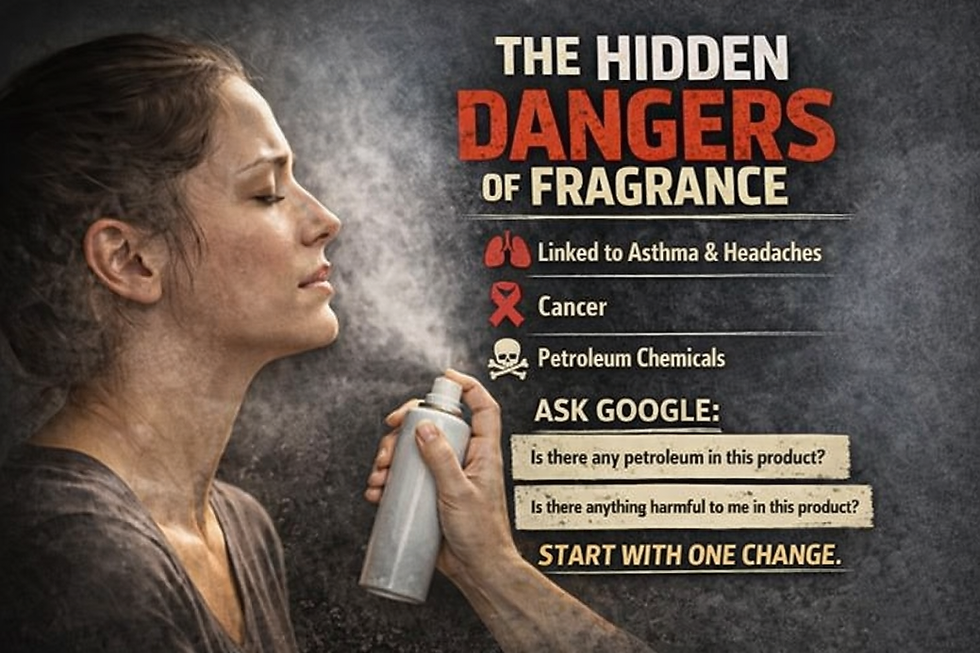
We fear cancer. We fear car crashes. We fear sharks.
Yet one of the most harmful exposures in our daily lives is something we’ve been taught to love.
Fragrance.
The Illusion of Fragrance
What we’ve been taught isn’t the truth
Fragrance is marketed as romance, cleanliness, and nature.
In reality, it is none of these.
“Fragrance” is a mixture of dozens to hundreds of undisclosed chemicals, about 95% derived from petroleum that are combined to create a scent cheaply. There are over 3000 ingredients that are used to create "fragrances" which are not required to be disclosed under current trade secrets laws.
The Dangers of Fragrance
What fragrance exposure can do to the body
Fragrance exposure is not linked to just one or two issues. It is scientifically proven that fragrance exposures may cause or worsen a wide range of symptoms affecting nearly every system in the body including these:
Systemic & Serious Conditions
Cancer, immune system dysfunction, inflammation, organ damage (liver/kidney), thyroid disorders
Respiratory
Asthma, wheezing, coughing, breathing difficulty, chest tightness, sore throat, nasal irritation, congestion
Neurological & Cognitive
Headaches, migraines, dizziness, difficulty concentrating, memory problems, fatigue, tremors, seizures
Skin & Immune
Rashes, eczema, hives, itching, swelling, contact dermatitis, allergic reactions, anaphylaxis
Hormonal & Reproductive
Hormone disruption, infertility, decreased fertility, menstrual irregularities, sperm damage
Digestive & Metabolic
Nausea, bloating, diarrhea, insulin resistance, obesity
Many people never connect these symptoms to fragrance exposure.
For me, these exposures cause severe reactions; coughing, severe frightening asthma, blocked or congested sinuses, reduction of hearing, ringing in my right ear, fatigue, intense pain, memory issues, and nausea.
This is not just personal. It is documented.
Go here to see the published research that shows the harm and dangers of fragrance.
The American Medical Association has recognized the harm of fragrances.
Go here to see their Fragrance Free Regulation , H-135.902
Inside Our Homes
Where exposure becomes constant
When you use scented products; laundry soap, shampoo, cleaners or other scented products you are not just adding a smell.
You are releasing a complex chemical mixture that off-gasses continuously.
These chemicals are absorbed into your clothing, walls, carpets, furniture, everywhere and then released back into the air over time.
You are breathing them 24 hours a day.
Laundry products are especially deceptive and toxic. When you add additional fragrances to your laundry, simply adds more contaminates to your life. They contaminate your clothes, washing machine and dryer, your home, and even the air around your home, often for miles. They are absorbed through your skin every day, all day long.
Beyond the Home
How fragrance pollution spreads
These chemicals don’t stay inside.
They enter the outdoor air as toxic gases, affecting other people, wildlife, and the environment.
Studies have found that dryer vents release dozens of volatile organic compounds (VOCs), including hazardous air pollutants like formaldehyde, benzene and acetaldehyde.
What we use in our homes becomes part of the air everyone breathes.
Continuous Exposure
The hidden danger of plug-ins and scented devices
Plug-in air fresheners and similar products create constant exposure.
They heat chemicals to release them into the air, producing VOCs and even more dangerous compounds when they interact with ozone.
Many contain carcinogens and endocrine disruptors.
This is not occasional exposure, it is continuous.
Essential Oils
Not as simple or as safe as they seem
Essential oils are often seen as safe because they are “natural.”
But they are highly concentrated. Producing a single pound can require hundreds or thousands of pounds of plant material; concentrating not only scent, but also pesticides and toxins.
Some are also diluted or processed with petrochemicals.
For me, they trigger severe asthma.
Natural does not always mean safe.
Why the Body Becomes Overwhelmed
Exposure beyond what nature intended
Our bodies were never designed to handle constant exposure to petroleum-based chemicals or highly concentrated plant compounds.
Even a strong immune system can become overwhelmed.
This is why reducing these exposures matters so deeply.
Returning to What Is Real
A different way to experience scent
We have been taught to trust these scents, to associate them with comfort, beauty, and even love.
But they are masking something harmful.
When you remove these toxins, something remarkable happens. Your body begins to heal. Your senses begin to return.
You start to notice what was always there:
The smell of rain.
Fresh air.
Flowers.
Food cooking.
The smell of our Earth.
These are the fragrances our bodies were designed to enjoy.
You don’t need chemicals to feel clean.
You don’t need toxins to experience beauty.
The Products I Use
So Few Products Are Truly Safe
Fragrance-free products can be toxic as well.
Keith’s and my lives were turned upside down last August by a “fragrance-free” shampoo, Vanicream. Our RV has still not recovered.
This experience affected me so deeply that I haven’t been able to fully write about it yet, but I will share that story soon.
Unfortunately, other products I tested did not go well either.
I had been disappointed when Dr. Bronner's Baby Unscented Pure-Castile Soap changed their formula, so I began testing two similar products in hopes of finding a safe alternative.
MamaSuds Soap looked promising. However, during testing, our VOC levels slowly rose the entire time. We were testing in our bathroom, and whenever I went in, my chest hurt and I felt dizzy. Later, I realized this product is not organic. For me, it was not safe.
I also tested Penns Hill Organic Olive Oil Soap. It initially passed my VOC meter test. A few days later, I used it. My chest felt tight, but I told myself it might just be fear, it had been so long since I had tried a new personal care or cleaning product.
That night, I couldn’t get warm and couldn’t sleep; both signs, for me, of a reaction. During the night, I developed a deep, severe cough unlike anything I had experienced before. The cough was still there when I woke up.
Keith noticed a pattern. He said the VOC levels went up while we were awake and dropped when we went to bed. When I checked, he was right. At 5:45, the VOCs began rising, reaching 756. While we slept, they dropped steadily, finally returning to green at 6:10 am.
That’s when I realized something important: I had only tested the Penns Hill soap for five hours. Now I know I need to test products for at least 12 hours to truly understand their impact.
Then Keith shared something unexpected, there was no longer any smell from Dr. Bronner’s. Their new formula had actually improved the product.
After testing three new products that all affected my health, even though they appeared safe, I made a decision. I am no longer going to test new personal or cleaning products.
We have found safety and simplicity in two trusted ones.
We love Dr. Bronner's Baby Unscented Pure-Castile Soap. We use it for handwashing, showering, shampooing, mopping, cleaning the sink, and most general cleaning.
For jobs that need more power, we use Bob's Red Mill Baking Soda.
By relying on just these two products, we have removed a huge amount of chemical exposure from our daily lives.
Choosing Safe Products
A Simple Way to Begin
If you react to the products I recommend or simply want other options there are many fragrance-free or unscented products available.
However, most products on the market still contain hidden chemicals, which can make choosing safely feel overwhelming.
Tools like Environmental Working Group’s Skin Deep® database and Cleaning Guide can be very helpful. They allow you to look up products and see the ingredients and potential toxins they contain. This can be a powerful way to begin learning what is actually in the products you use.
At the same time, I have learned something important: even highly rated products are not always safe for everyone. I have reacted to products with their top rated scores including Vanicream Shampoo, which caused me asthma. I have also seen products labeled “EWG Verified” that still contain fragrance.
These tools are helpful, but they are not the final answer.
I’ve found that it comes down to asking two simple questions on Google:
Is there any petroleum in this product?
Is there anything harmful to me in this product?
These questions cut through marketing, labels, and assumptions.
I have often been shocked by the answers.
They help you slow down, look deeper, and make decisions based on what truly supports your health.
You don’t have to change everything at once.
As each product runs out, you can decide what to replace it with or whether you need to replace it at all.
Start with one product. One decision.
Always do a smell test: if something smells like chemicals, it’s usually best to avoid it. As you make changes, notice how your body responds.
These tools and your body will guide you the rest of the way.

This site is the most comprehensive and accurate site Inhave found to help me learn more about scented products and why I react to so many scented products. A huge bonus is you let us know what products are safe. Thank you Teresa for leading the way in improving health and awareness through clear educational articles.
Thank you for this well written artical, Teresa! I couldn't agree more with you that frangrances are dangerous. I went completely fragrance free last year, and in that detox process; I was quite surprised how many products contained fragrances in my home (even a kayak conditioner).
You have so much insight and knowledge, and I pray your article reaches a multitude of people.
Very well written, Teresa!This article does what every good article leads to, which is action. I'm definitely working step-by-step to rid my house of chemicals.